
The right foundation can speed work, reduce errors, and deliver outcomes that matter to your business.
We know this from years of experience helping teams build and deploy intelligent systems that support real work.
In this guide, we will explain what AI agent frameworks are, why they matter, which ones stand out for 2026, and how to choose the right one for your situation.
What is AI Agent Framework & Why Is It Important
An AI agent framework is a collection of tools and structures that help developers create, run, and manage agents. These frameworks handle the routine parts of building agent systems so you can focus on solving real business problems rather than reinventing the basics.
For example, agent frameworks help with storing state, connecting to data sources, orchestrating tasks, and handling interactions.
By 2025, several agent frameworks had emerged as leaders in the space. Developers and product teams now choose from several frameworks depending on the scale, performance needs, and integration requirements of their projects.
In enterprise settings, these frameworks become part of your core infrastructure. Just as you choose a database or a cloud provider based on your long-term needs, you choose an agent framework to support applications that must work reliably and at scale.
Read More: Vertical vs Horizontal AI Agents
How Frameworks Evolved and What to Expect in 2026
AI agent frameworks originated as developer tools that enabled teams to experiment quickly with automation and task routing. Over time, they evolved to support more complex requirements such as multi-task workflows, agent collaboration, memory and state, and integration with business data and systems.
A study from tech industry observers showed that by late 2025, developers were working with at least a dozen major frameworks that facilitate agent creation, including some that support standard communication protocols across agents.
Another trend is the movement toward open standards. Industry groups and large firms have begun sharing technical standards that enable different agent systems to work together. This can reduce vendor lock-in and improve the portability of your work.
For 2026, we see this trend continue. Agent frameworks are becoming more robust, more modular, and easier to integrate with real business data. They no longer exist only in labs or as prototypes. Teams are now using them for mission-critical workflows in finance, operations, customer service, and beyond.
Read More: Multi-Tenancy in Cloud Architecture
Key Criteria You Should Consider for 2026
When you evaluate AI agent frameworks, think about these questions:
Can the framework work with your existing data and systems? Your AI agents should fit into your environment, not force you to rebuild the stack.
Does it support collaboration among multiple agents? Some tasks require several agent roles working together.
How do you measure performance and reliability? You need clear ways to monitor and control what agents do.
Does the framework help with long-term tasks that involve memory and state? Your workflows may span days or weeks.
Can teams maintain and update agents quickly without rewriting the whole system? Production readiness matters.
These criteria influence both developer cost and business outcomes.
Read More: Why CFOs Should Partner with Gen AI-Powered MSPs
Top AI Agent Frameworks in 2026 for Developers
Here are the AI agent frameworks that stand out as of the end of 2025, based on widespread community adoption, enterprise usage, and active development.
LangChain — Best for Flexible, General-Purpose Workflows
LangChain is one of the most widely adopted frameworks because it gives you the freedom to build almost any type of agent workflow. It works with many tools, data sources, and APIs, which means you can connect your agent to systems your team already uses. You can create simple workflows or large, multi-step processes without starting from scratch.
Many engineering teams pick LangChain when they want a long-term foundation. It is well supported, updated often, and backed by one of the largest developer communities. Because of this, your teams can build faster and fix problems without getting stuck.
LangChain is especially strong when your work spans several steps, such as research, routing tasks, combining information from many places, or supporting internal teams with repeatable workflows.
2. LangGraph — Best for Reliable, Stateful Workflows
LangGraph builds on LangChain and adds structure for more complex processes. When your workflow must stay predictable and stable, LangGraph helps you track state and follow steps in order. This is useful for businesses that need agents to behave the same way every time.
Teams often use LangGraph for operations, compliance, and reporting tasks. These jobs need clear instructions, clean handoffs, and strong error handling. LangGraph gives you a graph-like structure where each step can be tested, retried, or improved without breaking the whole system.
If you want agents that feel more like a workflow engine than a loose script, LangGraph is a solid choice.
3. AutoGen — Best for Multi-Agent Collaboration at Scale
Source: Microsoft
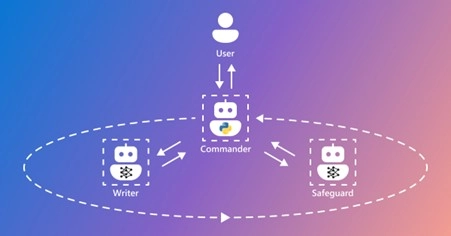
Microsoft’s AutoGen is designed for systems where several AI agents work together. Instead of one agent doing everything, you assign roles such as planner, researcher, reviewer, or solver. AutoGen helps these agents talk to each other and reach a goal together.
This is helpful when you have large tasks that require many skills. For example, you might have one agent plan a process, another gather information, and a third check the results. AutoGen manages the communication between them.
Because AutoGen is from Microsoft, it fits well in environments that already use Azure or Microsoft enterprise tools.
Read More: Multi-Agent Systems in AI
4. CrewAI — Best for Structured Teamwork and Clear Role Assignment
Source: CrewAI
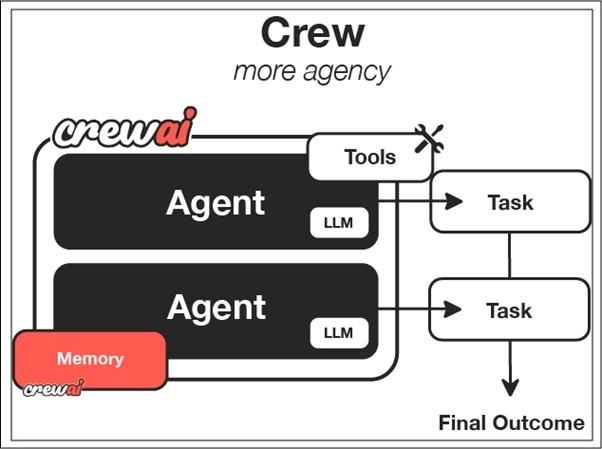
CrewAI focuses on teamwork. It lets you build groups of agents, each with a defined role. These agents share a task and work through steps together. This is helpful when you want a simple way to break work into smaller parts without building a complex system.
Many teams use CrewAI for research, writing, planning, and internal operations. It is straightforward to set up, and you can grow the system over time. If you want team-like behavior without learning a large framework, CrewAI is a good fit.
5. LlamaIndex — Best for Data-Heavy and Retrieval Workflows
Source: ResearchGate
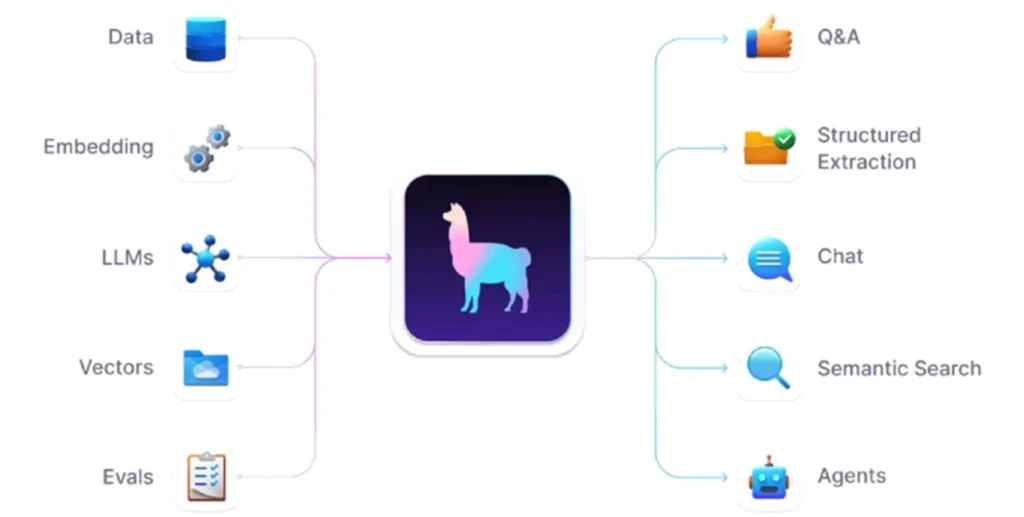
LlamaIndex is ideal when your agents must work with large amounts of information. It helps you index documents, structure data, and store records in a way that agents can search and use. This makes it a popular choice for customer support, compliance, financial reporting, and healthcare operations.
A common pattern in businesses is that teams spend too much time looking for the right information. LlamaIndex reduces that effort by letting your agents pull data directly from approved sources.
If your work depends on reliable information rather than creative output, LlamaIndex gives your agents the support they need.
6. Langflow — Best for Visual Builders and Fast Prototyping
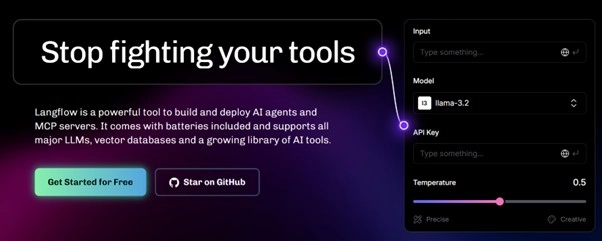
Langflow gives you a drag-and-drop interface for building agents. You can design your workflows without heavy coding. This is helpful for teams who want to test ideas fast or prototype before investing in deeper development.
Product managers, analysts, and early-stage engineering teams often use Langflow because they can build working flows in a few minutes. It is built on LangChain, so anything you build visually can later be expanded in code.
7. Botpress — Best for Conversational Workflows and Customer Support
Botpress is made for conversations. It has a visual builder for designing dialog flows and connecting to customer systems. If your team needs agents to respond to users, guide customers, or handle multi-turn interactions, Botpress helps you build these flows without complex development.
Many support teams use Botpress because they can update flows on their own and respond to changes in customer needs quickly.
8. N8N — Best for Automation and Low-Code Integration
N8N is a workflow automation platform with strong support for agent functions. You can connect your agents to hundreds of tools, cloud apps, and internal services. Since it is open-source, your team has the freedom to customize and run it in-house.
N8N is ideal for teams that want a low-code approach but still need the flexibility to build advanced workflows.
9. Microsoft Semantic Kernel — Best for Enterprise and Microsoft Ecosystems
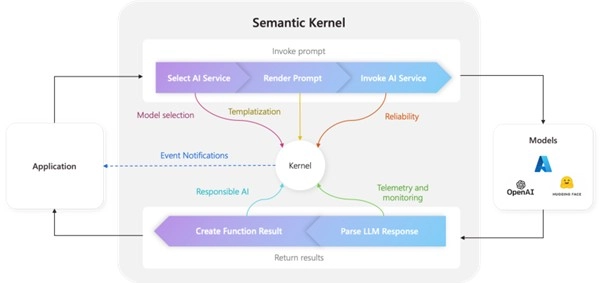
Source: Microsoft
Semantic Kernel fits naturally inside Microsoft environments. If your company uses Outlook, Teams, Dynamics, or Power BI, this framework helps your agents work inside those tools. It supports plugins, memory, and integration paths that fit enterprise security standards.
Large organizations use Semantic Kernel because it matches their governance needs and works well with their existing technology stack.
How These Frameworks Are Used in Real Work
Here is a comparison table of each framework:
| AI Framework | Best Use Case | Strengths | Ideal For |
| LangChain | General-purpose workflows | Flexible, large ecosystem | Teams needing a long-term foundation |
| LangGraph | Structured workflows | Strong state handling | Compliance, operations, reporting |
| AutoGen | Multi-agent teamwork | Role-based coordination | Large tasks with many steps |
| CrewAI | Team-like behavior | Simple role assignment | Research, writing, internal ops |
| LlamaIndex | Data retrieval | Strong indexing & search | Support, compliance, finance |
| Langflow | Visual prototyping | Drag-and-drop builder | Fast testing and demos |
| Botpress | Conversational flows | Visual dialog builder | Customer support teams |
| N8N | Integration & automation | Open-source, low-code | Mixed technical teams |
| Semantic Kernel | Enterprise apps | Fits Microsoft stack | Large firms with strict controls |
As of 2025 and moving into 2026, many organizations are starting to rely on agent frameworks to improve operational efficiency. For example, developer communities show a wide range of usage patterns:
- Some companies use frameworks like LangChain to automate document processing and routing.
- Others use multi-agent frameworks to break down complex tasks into smaller steps that different agents handle.
- Teams focused on deep data tasks often choose frameworks like LlamaIndex because of their strength in retrieval and structured data workflows.
These examples show that frameworks help teams reduce time spent on routine work and focus more on business goals.
Which Framework Might Be Right for You?
There is no single answer. The best framework for your team depends on your needs.
If you need flexibility and broad integration, LangChain is a strong choice. If you want built-in support for collaboration and role decomposition, CrewAI or AutoGen makes sense. If your work revolves around structured data and retrieval, options like LlamaIndex or enterprise embedding frameworks may serve you well.
When you evaluate frameworks, involve your technical and business teams together. Consider not just developer familiarity but also how the framework helps you reach your business outcomes.
Future of AI Agent Frameworks: What to Expect in 2026
AI agent frameworks are entering a new stage. Until now, most companies used them for pilots or small internal projects. In 2026, the shift is toward production systems, where agents handle real work that affects revenue, cost, and customer experience.
Research from IDC shows that 60 percent of global companies plan to deploy agent-based systems in production by the end of 2026, driven by pressure to automate slow or repetitive work.
Another survey found that 72 percent of technology leaders plan to increase spending on automation tools, naming agent frameworks as a top investment area.
Here are the clear reasons of the AI agents growth including:
1. Companies want stronger control over their systems
As businesses scale up their use of agents, they want frameworks that offer:
- clear task boundaries
- safe execution
- predictable behavior
- better monitoring and logs
A recent report showed that 74 percent of companies building agent systems now consider governance and traceability a must-have, not a nice-to-have.
This means the winning frameworks in 2026 will be the ones that help teams track what agents do, store history, and maintain reliability even when tasks run for long periods.
2. Multi-agent systems are becoming the new standard
Teams no longer want one agent that tries to do everything. They want several agents working together, each with a clear role. This trend is backed by engineering adoption data showing that solutions with multi-agent support grew over 300 percent year-over-year across open-source communities.
The reason is simple:
When each agent focuses on one skill, the entire system becomes easier to maintain, test, and scale.
Frameworks like AutoGen, CrewAI, and LangGraph will grow faster in 2026 because they fit this direction.
3. Companies want to use their own data with less friction
Most business tasks depend on internal data, not public information.
This is why frameworks that support retrieval, indexing, and structured data will grow the fastest.
A 2024 industry study found that 80 percent of enterprise automation failures happened when teams could not connect their tools to their internal data sources.
Frameworks like LlamaIndex and Microsoft Semantic Kernel solve this problem. In 2026, adoption of these tools is expected to grow because companies want agents that can work directly with:
- documents
- records
- transaction logs
- internal systems
- enterprise workflows
The ability to use structured company data is becoming a baseline requirement.
4. Open standards will shape the next generation of frameworks
In 2025, major providers such as OpenAI, Anthropic, and Block announced efforts to build shared standards for agent-to-agent communication. This move signals a shift toward interoperability.
By 2026, these standards will make it easier to:
- mix tools from different vendors
- move workflows across systems
- avoid lock-in
- adopt the best framework for each use case
This is like how cloud standards evolved a decade ago.
5. Enterprises want lower operating costs
Companies are under pressure to reduce cost without shrinking output. A McKinsey report found that teams using automated workflows saw productivity gains of 20 to 30 percent across core operations.
In 2026, leaders will choose frameworks that help reduce:
- rework
- manual review
- duplicate processes
- cloud usage cost
This means frameworks that support smarter routing, better state management, and efficient workload execution will gain adoption.
LangGraph, AutoGen, and N8N are positioned well in this category.
6. Visual development tools will grow as business teams get more involved
Low-code and no-code frameworks are expanding quickly. According to industry forecasts, visual workflow tools are expected to reach a global market size of nearly $100 billion by 2030, driven by non-technical teams needing to automate work.
In 2026, frameworks such as Langflow, Botpress and N8N will see major growth because product teams, operations teams, and support teams want to build workflows on their own.
When you evaluate agent frameworks, look for signs that the framework will stay relevant in 2026 and beyond:
- Is it built for multi-agent systems?
- Does it support real governance?
- Can it work with your data?
- Does it scale as your workload grows?
- Does your team have the skills to maintain it?
These questions help you pick a system that can handle not just today’s use cases, but the next decade of workflows.
Final Thoughts
Choosing the right agent framework is more than a technical decision. It is a strategic one that affects your team’s productivity, your operating cost, and your ability to meet business goals.
The landscape will look different in 2026 than it did a few years ago, but the core challenge remains the same: pick tools that help your teams move work forward with confidence.
We encourage you to take a thoughtful, criteria-based approach to framework selection. Use this guide as a starting point for discussions across your teams.
If you want to evaluate frameworks in detail, test small workflows, and measure outcomes, you will be well-positioned to choose the right path for your organization.
At Sthenos, we develop AI agents tailored for your business needs. For more clarity on which AI agent frameworks are best suited for you, schedule a consultation with one of our AI experts.