Today, we are going to compare React Native vs Kotlin Multiplatform. Which one is better in 2026?
React Native is best for faster development, smaller teams, and cross-platform MVPs. Kotlin Multiplatform suits apps that demand native performance, scalability, and deeper hardware integration.
In this blog post, we’ll help you understand how these frameworks compare in real-world use. You’ll see how they differ in performance, scalability, development speed, and long-term cost, and which one makes sense for your project goals.
Best for faster development, smaller teams, and cross-platform MVPs.
Suits apps that demand native performance, scalability, and deeper hardware integration.
Respondents to JetBrains’ Developer Ecosystem survey using each cross-platform mobile framework; KMP was 7% in 2024.
If your team already has JavaScript/React skills, adopting React Native can be low friction.
Quick Snapshot: Key Differences
Here’s a summary to orient us:
| Criteria | React Native | Kotlin Multiplatform |
| Language | JavaScript (with React) | Kotlin |
| Ecosystem Maturity | Highly mature | Rapidly growing |
| Performance | Near-native | True native code sharing (no JS bridge) |
| Hot Reload | Built-in, strong advantage | Not typically supported in the same way |
| Best For | Cross-platform MVPs, fast time-to-market | High-performance apps, deep native APIs |
We’ll unpack each of these in detail because what works best depends on your project’s needs, team, and long-term vision.
React Native: The Veteran of Cross-Platform Development
Let’s look at what React Native brings to the table today.
React Native is an open-source mobile framework created by Meta (formerly Facebook) and built around the React paradigm for mobile apps. Because it taps into a massive JavaScript ecosystem, many teams already have skills they can reuse.
Strengths:
- Code reuse: You can write one codebase and deploy to both iOS and Android, which accelerates delivery.
- Hot reload: Makes iterations fast, which is ideal for MVPs or when you need quick feedback loops.
- Large ecosystem: There are many libraries, plug-ins, and existing solutions you can leverage.
- Developer availability: JavaScript/React skills are widely available in the market.
In the 2025 State of React Native survey, 71.1% of respondents had used Expo Router, and React Native Reanimated was the most used graphics and animations solution, used by 93.2% of respondents.
Weaknesses:
- Native feature access: While many native APIs are supported via modules, sometimes you’ll need platform-specific “plumbing,” which increases complexity.
- Performance ceiling: For extremely complex apps with heavy UI/animation/device-integration demands, React Native may not fully match native code.
So, if you or your team are comfortable with JavaScript and you need to move fast into both platforms, React Native remains a solid choice.
Kotlin Multiplatform: The Native-First Challenger
Now, let’s examine Kotlin Multiplatform and how it is evolving in 2026.
Kotlin is a language developed by JetBrains and endorsed by Google for Android development. The “multiplatform” extension allows you to share code (especially business logic) across platforms while maintaining native UI per platform.
Strengths:
- True native code: Because you share business logic, networking, models, etc., but keep UI native, you get high performance and full access to platform APIs.
- Incremental adoption: If you have an existing native Android (or iOS) team, you can gradually introduce shared modules rather than rewriting your app wholesale.
- Growing adoption: For example, companies such as Netflix, McDonald’s, and Philips are cited as using Kotlin Multiplatform.
So, if your app is performance-critical, you already have native expertise, or you plan to scale heavily, Kotlin Multiplatform is increasingly compelling.
Weaknesses:
- Ecosystem still maturing: Although rising, third-party libraries, community size, and plug-ins are not as extensive as React Native’s ecosystem.
- Requires native knowledge: Your team may still need advanced platform-specific skills (Swift/Compose, native modules).
- Learning curve & tooling: In some cases, tooling and patterns (for multiplatform modules) are still catching up.
Other issues include debugging complexities, integration issues, IDE problems, and limited MAC OS availability.
Read More: Flutter vs Kotlin Multiplatform
Performance Showdown: Real-World Use
When comparing React Native vs Kotlin Multiplatform, performance is the key decision axis. Here’s how they stack up.
Code-sharing & reuse:
- Shared business logic in Kotlin modules means less duplication, fewer bugs, and simpler maintenance for logic that applies across platforms.
Performance and native integration:
- Kotlin Multiplatform allows the UI layer to remain purely native (Compose for Android, SwiftUI for iOS), which removes the bridging penalty inherent to many frameworks.
- React Native is great. But in scenarios where you require ultra-smooth animations, heavy device integration, or minimal start-up latency, the native edge may tilt toward Kotlin Multiplatform.
If your app is standard (forms, lists, basic UI) and you need speed to market, React Native gives you most of what you need.
If your app is custom-built (e.g., fintech, IoT, high-end animation, deep native features), then Kotlin Multiplatform may deliver better long-term value.
Developer Ecosystem & Community
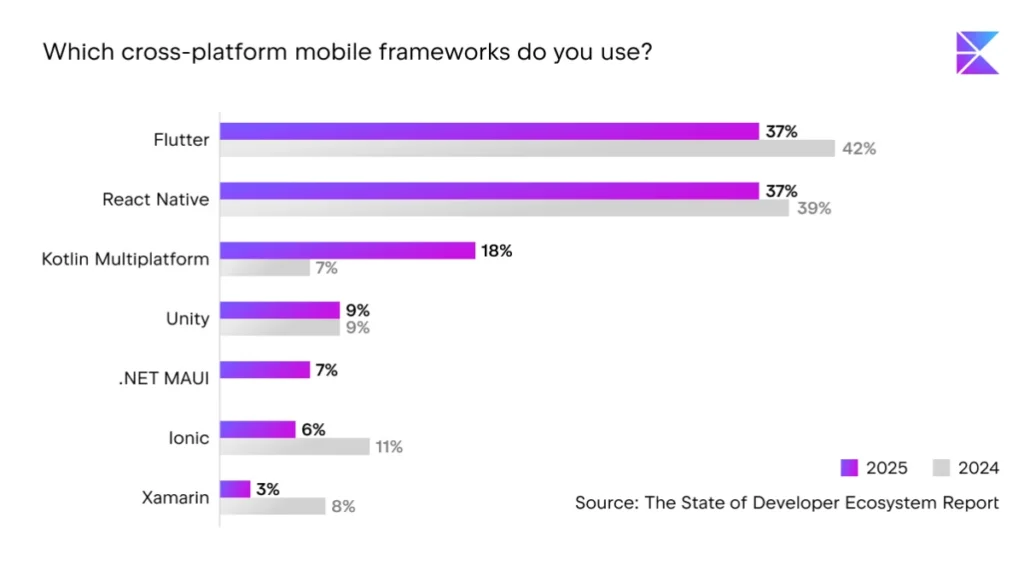
Source: JetBrains
In JetBrains’ chart of its State of Developer Ecosystem Report 2025, 37% of respondents use Flutter and 37% use React Native, while 18% use Kotlin Multiplatform. But the use of Kotlin Multiplatform has more than doubled since last year, highlighting the growing momentum.
Community & popularity:
- React Native has a huge developer pool and mature ecosystem, which means hiring is generally easier and you’ll find many libraries/plugins.
- Kotlin Multiplatform’s community is smaller but growing quickly.
Hiring and skills:
- If your team already has JavaScript/React skills, adopting React Native can be low friction.
- If you have (or plan to build) a native team (Kotlin/Swift), then adding Kotlin Multiplatform may be more aligned with your roadmap.
Future proofing:
- Because Kotlin Multiplatform allows you to reuse logic while retaining native UI, you’re well-positioned for future platforms (desktop, web, perhaps AR/VR) where Kotlin is expanding.
- React Native continues to evolve (e.g., new architecture, JSI improvements), so it remains strong, but you must stay on top of updates and architecture changes.
Assess your talent pool now and three years out. If you anticipate scale, heavy performance demands, or want to leverage native skills, lean into Kotlin. If you want to launch fast, leverage JavaScript talent and go cross-platform early, lean on React Native.
Cost, Time, and Resource Comparison
Let’s speak plainly about market time, cost, and resources.
Team size and resources:
- React Native often allows smaller teams since one team covers both platforms.
- Kotlin Multiplatform may require more upfront expertise, especially if mixing multiplatform modules with native UI teams.
Cost table (estimate):
| Factor | React Native | Kotlin Multiplatform |
| Developer cost/hr | Lower (JavaScript talent abundant) | Slightly higher (Kotlin + native skills) |
| Time to MVP | Shorter (fast iteration) | Slightly longer |
| Maintenance | Moderate | Potentially lower in the long term |
| Best fit | Rapid cross-platform launch | High-performance, native-centric apps |
If you’re a startup or lean team launching quickly, React Native is likely more cost-efficient.
If you expect your app to scale heavily, have complex native features or long-term maintenance burdens, the extra investment in Kotlin Multiplatform may pay off.
Integration & Scalability
Beyond writing code, you’ll integrate your mobile app with backend services, analytics, device features, and cloud functions. Let’s compare how each framework supports that.
Backend/cloud/analytics integration:
- React Native has extensive libraries and plug-ins for Firebase, AWS Amplify, Azure, GraphQL, etc.
- Kotlin Multiplatform allows you to share logic modules like networking, data storage, state management, and keep platform-specific UI layers. That means you can standardize your business logic while still leveraging native SDKs and tools for device features.
Device and native feature access:
- If your app needs deep access (e.g., biometric scanners, custom hardware, AR/VR, sensors), then Kotlin Multiplatform gives you more direct native access.
- React Native supports many modules, but sometimes you’ll hit limitations or need custom native bridging.
Scalability and architecture:
- Because KMP supports a “shared core with native UI” architecture, you can maintain high-quality UI on each platform while reusing logic. That supports large teams or apps with multiple modules.
- React Native is very scalable too, but requires discipline in architecture, native bridging, and performance tuning, especially at scale.
Figure 1. One codebase, or a shared core with native UI
Built from this article’s own descriptions: React Native lets you write one codebase and deploy to both iOS and Android; Kotlin Multiplatform shares logic modules such as networking, data storage and state management, while the UI stays native on each platform (Compose for Android, SwiftUI for iOS).
If you plan to integrate with advanced features (AI modules, custom hardware, enterprise backends) and you need scalability, lean toward Kotlin Multiplatform.
If integration needs are more standard (APIs, data sync, push notifications, analytics) and your priority is speed and team efficiency, React Native fits well.
When Should You Choose React Native
Here are the scenarios where we believe React Native is the optimal choice:
- You are a startup or small team launching both iOS and Android, and you need to move fast.
- Your team already has JavaScript/React expertise.
- Your app’s feature set is moderate: forms, lists, basic UI, and typical device integrations.
- You want to maximise code reuse, prototype quickly, and get to market early.
- Long-term native performance is less critical than speed and cost.
In those cases, choosing React Native makes strategic sense as it provides strong value and wide community support.
When Should You Choose Kotlin Multiplatform
Here are the situations where we lean toward Kotlin Multiplatform:
- You’re building a high-performance app: heavy animations, fintech, IoT, enterprise features.
- You already have a native Android (or iOS) team, so you’re comfortable with Kotlin or Swift.
- You expect your app to scale significantly, maintain over many years, or require complex native APIs.
- You want to share business logic across platforms but give each platform full native UI fidelity.
- You’re willing to invest somewhat more upfront for a potentially lower cost of ownership over time.
In those scenarios, Kotlin Multiplatform provides native performance and cross-platform efficiencies.
The 2026 Outlook: The Future of Cross-Platform Development
Looking ahead, here’s what we believe will shape the next wave of mobile development:
Frameworks will converge
Expect both React Native and Kotlin Multiplatform to continue improving in performance, tooling, and ecosystem.
Shared logic becomes central
More firms will adopt architectures where business logic is shared and UI is native per platform, exactly something Kotlin has leaned into.
Multi-device targeting
With wearable, TV, desktop, and even AR/VR platforms growing, multiplatform frameworks will need to handle more than just iOS/Android.
Developer experience matters
Speed of iteration, tooling, and hot-reload-like feedback loops will be increasingly important.
Ecosystem shifts
New libraries, plug-ins, and cloud-mobile integrations will drive differentiation.
So, while the choice between React Native and Kotlin Multiplatform matters now, what matters more is adopting a framework that evolves with your business’s next 3 to 5 years.
Final Thoughts
Both React Native and Kotlin Multiplatform are exceptional frameworks, but their value depends on what you’re building.
If your focus is rapid development, smaller teams, and a fast go-to-market strategy, React Native remains a solid, proven choice. It’s mature, backed by a massive ecosystem, and lets you quickly launch on Android and iOS.
If your goal is long-term scalability, deeper system integrations, and performance that matches native apps, Kotlin Multiplatform offers a future-ready approach. Its ability to share business logic while keeping native UI layers makes it ideal for enterprise-grade or resource-intensive apps.
At Sthenos, we approach projects by balancing performance, scalability, and cost. If you’re planning your next mobile project, our consultants can help you evaluate which framework aligns best with your technical roadmap and business vision.
Schedule a free consultation call with one of our experts.
Frequently Asked Questions
Which framework is better for building cross-platform apps: React Native or Kotlin Multiplatform?
Both frameworks deliver cross-platform results, but the right choice depends on your priorities. React Native is ideal for faster app launches and smaller teams because it uses a single JavaScript codebase. Kotlin Multiplatform is better suited for apps that demand native performance, advanced hardware integration, or long-term scalability. At Sthenos, we often recommend React Native for MVPs and Kotlin Multiplatform for enterprise solutions.
Is Kotlin Multiplatform stable enough for production apps in 2026?
As of 2026, Kotlin Multiplatform is fully production-ready for core features and widely adopted by global brands such as Netflix, McDonald’s, and VMware. JetBrains continues to enhance its stability, and Google’s ongoing support further strengthens its credibility. While some advanced components are still evolving, its core SDK is stable enough for enterprise-grade applications.
Does React Native support both iOS and Android equally well?
React Native allows you to develop for both platforms from a single codebase, ensuring near-native performance. You may occasionally need to write platform-specific code for advanced features, but for most business applications (e-commerce, content, and productivity tools), it performs consistently across iOS and Android.
Can an existing React Native app be migrated to Kotlin Multiplatform?
Yes, and it doesn’t require starting from scratch. Many companies begin with React Native for speed and then transition parts of the app to Kotlin Multiplatform when performance and scalability become critical. The migration can be done in stages by sharing business logic first and later rewriting UI components in native Kotlin, reducing overall project risk.
What type of app should startups or enterprises build with each framework?
Startups launching their first product or MVP should consider React Native for its faster development cycle and larger talent pool. Enterprises handling performance-heavy workloads (fintech, logistics, or data-intensive apps) will find Kotlin Multiplatform more suitable. At Sthenos, we often combine both strategies to help businesses scale from prototype to enterprise-grade platforms.
Is it easier to hire React Native developers or Kotlin Multiplatform developers?
React Native has a huge developer pool and mature ecosystem, which means hiring is generally easier. Kotlin Multiplatform’s community is smaller but growing quickly.