Custom ERP Development for Enterprise Process Integration
Updated














Custom ERP Development Services
Custom ERP Software Development
Building custom ERP solutions tailored to business processes, reporting structures, and operational priorities. Sthenos develops ERP platforms that consolidate data, automate workflows, and improve coordination across teams.
- Flexible and extensible system architecture
- Improved data integrity and consistency
- Real-time operational and management reporting
- Reduced data duplication across systems
- Stronger inter-department collaboration
ERP Implementation and Upgradation
Helping enterprises implement and upgrade ERP systems with minimal disruption to ongoing operations. Sthenos manages ERP rollouts and upgrades with a focus on usability, performance, and long-term reliability.
- User-friendly and accessible interfaces
- Rapid implementation and version upgrades
- Lower operational and maintenance costs
- Improved scalability for growing organizations
- Secure upgrades with data protection
ERP Migration and Integration
Supporting organizations through secure ERP migrations and complex system integrations. Sthenos ensures data accuracy, continuity, and transparency while connecting ERP platforms with surrounding enterprise applications.
- Business-focused data migration approach
- Removal of obsolete and redundant data
- Automated workflows across systems
- Centralized access to enterprise data
- Improved cost efficiency and operational focus
Testing and QA
Ensuring ERP systems are stable, secure, and ready for enterprise use before go-live. Sthenos delivers structured testing and quality assurance to reduce risk, improve adoption, and support long-term system performance.
- Higher system reliability and stability
- Reduced downtime and post-launch issues
- Improved user adoption and confidence
- Stronger productivity and operational efficiency
Business success with next-gen ERP solutions





Sthenos builds custom ERP software and implements, upgrades, migrates, integrates and tests ERP platforms, the four services set out above. Our ERP implementation work treats the seam between finance and operations as the first deliverable rather than the last, because that seam, not either side of it, is where ERP implementation fails most often.
Custom development, implementation and upgrades, migration and integration, testing and QA.
Staged by business unit, because a single cutover puts all the risk on one weekend.
We are platform-independent, so the recommendation is the one that fits.
Depending on the seniority and mix of the team.
On this page
- What ERP software development covers
- ERP integration: one agreed source of truth per field
- ERP implementation steps
- Custom ERP software or a packaged ERP
- What moves the cost of an ERP implementation
- What you receive from an ERP engagement
- What to ask any ERP development company
- More questions about ERP development
- Related pages, by what you are deciding
- Talk to our engineers
What ERP software development covers
SAP describes enterprise resource planning (ERP) as a software system that runs an organization's core processes, finance, HR, manufacturing, supply chain, sales and procurement among them, from a unified view and a single source of truth (SAP, What is ERP). ERP software development is the work of making that system fit a business: building custom ERP software around its processes, reporting structures and operational priorities, or implementing, upgrading, migrating and integrating a packaged ERP platform.
Custom ERP development here is aimed at the outcomes this page lists: data consolidated across teams, automated workflows, real-time operational and management reporting, and less duplication of data across systems.
The ERP platforms on this page
ERP integration: one agreed source of truth per field
Our ERP system integration between finance, inventory, procurement and your CRM is built on one agreed source of truth per field. Integrating ERP with an existing CRM is usually the highest-value part of the work: quote, order and invoice moving without re-keying removes the largest source of manual error in most organisations.
Two of our industry pages say where else the ERP sits. For ecommerce and retail, the ERP is the master record for products, cost, stock and the ledger, and when the storefront and the ERP disagree about price or availability, the customer has already checked out. For manufacturing, ERP software is where most shop floor data has to land before anybody outside operations sees it.
Figure 1. Where the ERP sits, and the seam that decides the programme
Caption: every box is a system this page, our Salesforce consulting page, or our ecommerce and retail and manufacturing pages name, in those pages' words. The dashed line is the seam between finance and operations, which our ERP implementation work treats as the first deliverable. The heavier line is the CRM link this page calls the highest-value part of the work. No volume, timing or vendor is shown.
ERP implementation steps
An ERP programme runs through the stages our Salesforce consulting page sets out for a CRM or ERP programme. Each step below adds the ERP-specific point from this page's own services and answers, and names the service on this page that does the work.
- Discovery, and one owner of the data modelWe get one named decision-maker in writing during discovery, because when finance and operations disagree about what a customer or a product is, every integration inherits that argument.Written data model owner
- Platform and scope decisionA written recommendation with the fit, the licence cost and the honest trade-offs of each option, including doing nothing. This is the ERP selection step.Written recommendation
- Configure, then buildConfiguration first, custom code only where configuration provably cannot do it. Where the answer is custom ERP software, it starts from a flexible and extensible system architecture.Custom ERP Software Development
- Migrate and reconcileA business-focused data migration that removes obsolete and redundant data, moved with a reconciliation report showing counts in and out, so nothing is assumed to have landed.ERP Migration and Integration
- Test before go-liveStructured testing and quality assurance, so the system is stable, secure and ready for enterprise use before go-live.Testing and QA
- Go live by business unitStaged by business unit wherever the organisation allows it, because a single cutover concentrates all the risk on one weekend.ERP Implementation and Upgradation
- Enable and hand overTraining, documentation and a support window. You own the system at the end, not a dependency on us.Handover
ERP implementation best practices
The single strongest predictor of a successful rollout is not the platform. It is whether one named person on your side owns the data model and can settle disputes about it, and programmes without that person stall at integration.
- One named owner of the data model, agreed in writing during discovery.
- The seam between finance and operations treated as the first deliverable.
- Configuration before custom code, and every custom object justified in writing.
- A reconciliation report for every data migration.
- Testing before go-live, and a go-live staged by business unit.
Custom ERP software or a packaged ERP: which one suits you
Custom ERP software development is the right call in a narrow set of cases, and we will tell you plainly when yours is not one of them. When it is the answer, it is built on the same stack we use for any product work, so an ordinary engineering team can maintain the result rather than only us.
Configure a packaged ERP
When buying wins- A packaged product covers the work, and someone else carries the maintenance.
- A small team.
- A business that will change shape again within two years.
Build custom ERP software
When a build wins- A workflow no vendor models.
- Heavy per-seat cost against low per-seat usage.
- Data residency rules a SaaS platform cannot meet.
The middle path
Keep, build, integrate- Keep the platform for the standard objects.
- Build only the one process that is genuinely yours.
- Integrate the two properly.
The rollout is a second choice, separate from the platform. We stage go-live by business unit wherever the organisation allows it, and avoid the single cutover, because a single cutover concentrates all the risk on one weekend.
What moves the cost of an ERP implementation
The cost of an ERP implementation depends on module count and on how much finance and operations data has to be migrated, and the seam between finance and operations drives more of the cost than either side alone. Where the scope is clear we quote a fixed price for a defined outcome, with a costed roadmap before any build starts.
The rate depends on the seniority and mix of the team, which is the stated reason the band has a range at all.
What you receive from an ERP engagement
- A named decision-maker for the data model, agreed in writing during discovery.
- A written platform and scope recommendation, including the option of doing nothing.
- A reconciliation report showing counts in and out of every data migration.
- A system tested for stability and security before go-live.
- Training and documentation for the people who will run it.
- On a custom build, the repository and the cloud accounts in your name from the first commit.
What to ask any ERP development company
Most of these come from the answers on this page and our Salesforce consulting page, and they apply to any firm on your shortlist.
- Who owns the data model on our side, and is it in writing? No single owner of the data model is what causes most ERP projects to fail.
- Will go-live be staged, or one cutover? A single cutover concentrates all the risk on one weekend.
- Do you resell licences? If yes, ask how that affects the edition they recommend.
- How much will be custom code? Configuration should come first, and custom code only where configuration provably cannot do it.
- Show me the data reconciliation from your last migration. Serious firms have one. It is the only proof the migration worked.
- What documentation is a contractual deliverable? Knowledge that left with the vendor is what a client discovers too late.
More questions about ERP development
What is ERP software development?
It is the work of making an ERP system fit a business: building custom ERP software around its processes and reporting, or implementing, upgrading, migrating, integrating and testing a packaged platform. SAP describes ERP itself as the software system that runs core processes such as finance, HR, supply chain, sales and procurement from a single source of truth.
What are the ERP implementation phases?
Discovery with one named owner of the data model, a written platform and scope decision, configuration before custom code, migration with a reconciliation report, testing before go-live, a go-live staged by business unit, and handover with training and documentation.
Do you offer Odoo ERP development services?
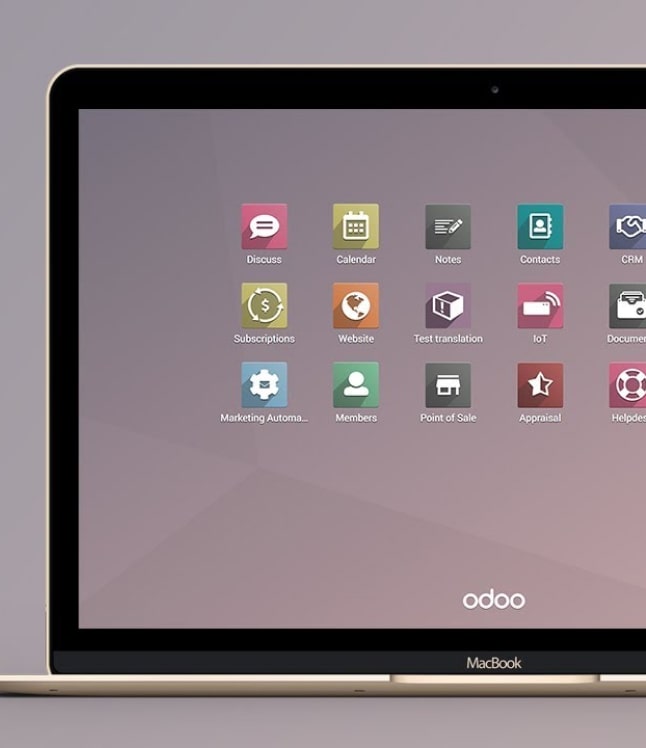
Yes. Our Odoo work covers implementation, module configuration and migration from spreadsheets or a legacy system, covering finance and inventory as well as CRM, and where an existing Odoo deployment has drifted we also take on remediation work.
Can you upgrade the ERP version we already run?
Yes. ERP implementation and upgradation on this page covers version upgrades with minimal disruption to ongoing operations, with a focus on usability, performance and long-term reliability, and with data protection during the upgrade.
Do you work on SAP ERP?
Yes. SAP consulting, SAP S/4HANA implementation, SAP hosting and SAP application management services have their own page, SAP solution.
Related pages, by what you are deciding
Ready to scope an ERP programme? Tell us the platform you are on, the process that is not working and the deadline you are working to. Talk to our engineers.
Enterprise Resource Planning (ERP) solutions
Cloud-Based ERP Application for a Global Manufacturing Enterprise
A global manufacturer operating on a legacy ERP platform faced operational bottlenecks and limited visibility across inventory and production workflows. The business required a rapid transition to a modern ERP environment without disrupting ongoing operations.
A cloud-based ERP solution was implemented using Microsoft Dynamics 365 Business Central, enabling faster decision-making, improved process efficiency, and better inventory control within a compressed delivery timeline.

Custom ERP Solution (Odoo) for a Large Retail Organization
A large retail enterprise struggled with fragmented systems, manual processes, and inconsistent data across departments. Multiple legacy platforms created delays in order processing and limited operational efficiency.
A unified Odoo-based ERP solution was implemented, covering inventory management, order processing, customer management, and finance. The centralized platform improved workflow consistency and accelerated transaction cycles across the organization.
ERP System Modernization for a Global Healthcare Brand
A global healthcare organization relied on an off-the-shelf ERP system that no longer supported evolving regulatory and operational requirements. The existing platform limited scalability and process efficiency across critical functions.
The ERP system was modernized with a custom-built solution supporting patient management, billing, and scheduling. The updated platform streamlined administrative workflows and improved cost control across the organization.