The constraint has never been technology, since model access is everywhere now. What buyers actually need is a partner who can plug an agent into a core banking platform, a claims engine, or a CRM with two decades of customizations stacked on top, and keep it running through the next audit cycle.
This guide reviews the AI agent development companies that mid market banks, insurers, healthcare systems, and enterprise IT leaders actually trust in 2026, and breaks down where each one fits best.
Key takeaways
Real agent architecture, governance for non deterministic systems, integration, production observability and unit economics, and outcomes in business numbers.
Each holds up to all five tests, and each section names who the firm is best for.
The regulatory weight of the system, whether the agent is the product, and how long the runway is.
Whether the program is scoped against a number the business will defend a year from now.
Disclosure: we are on this list. We publish this guide. We list ourselves last and do not rank any firm, so treat our entry as a declared interest rather than a hidden one. How the list was built: each firm was checked against the five tests in the next section. The list is not a ranking: the firms appear in no order of merit, with ours last. Check every firm’s claims, ours included, against its own pages before you shortlist.
What Separates a Real AI Agent Development Company from a Reseller
Five tests. The firms below clear all of them.
- Real agent architecture, not chat with extra steps. Production agent work covers orchestration, tool use, working memory, planning loops, retries, and clean failure paths. If the architecture diagram on slide six is one LLM call wrapped in a UI, that is a 2023 product wearing a 2026 hat.
- Governance built for non deterministic systems. Models hallucinate, drift, and occasionally refuse. The scaffolding around them has to do real work, including eval pipelines that catch drift, prompt and model versioning, PII handling that survives an audit, observability that traces a decision back to its inputs, and documentation discipline that lets a regulator follow the chain.
- Integration into the systems that run the business. Agents earn their keep by acting inside ERPs, CRMs, core banking platforms, EHRs, ticketing systems, and order pipelines.
- Production observability and unit economics. Per task tracing, honest token reporting, fallback behavior, and a credible answer to the question “what does this cost when traffic doubles”. A pilot that looks great until the invoice arrives is not a partner worth scaling with.
- Outcomes denominated in business numbers. Resolution time, cost per query, revenue uplift, manual hours eliminated. If the proposed metric is “agents shipped” or “use cases live”, the conversation is still about activity, not result.
Ten AI agent development companies hold up to all five. Here they are, in no order of merit, with ours last.
The ten at a glance, and who each one is best for
Neurons Lab
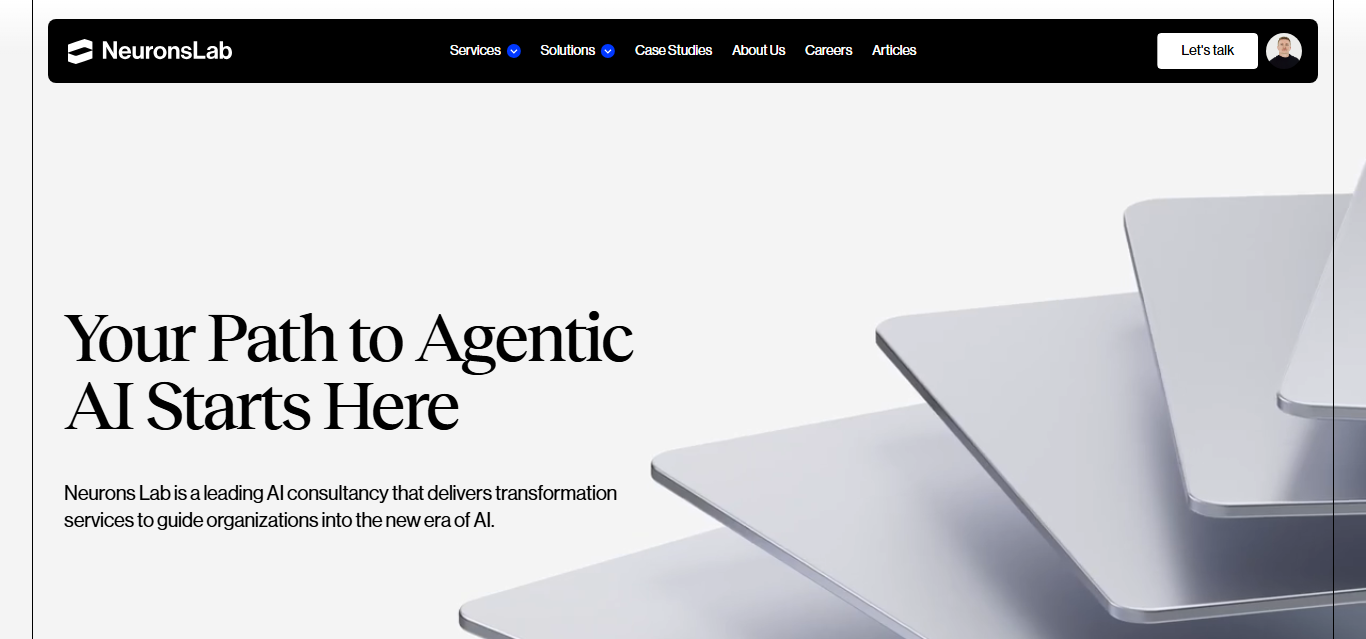
Headquartered in London with a Singapore office | AI consultancy | AWS Advanced Tier and GenAI Competency partner
Neurons Lab has built a credible foothold in agentic AI consulting for enterprise buyers that want a strategy partner before a build partner. The model is consultancy first, with proprietary delivery accelerators that compress the early stages of a program. The AWS Generative AI Competency is the differentiator most often worth raising in a sales conversation.
Their strongest delivery footprint sits in financial services, with active work on agentic banking, multi agent operations, and production GenAI prototypes that are positioned to graduate to scale rather than die in pilot purgatory.
Best for: Enterprise teams in regulated industries that want senior AI strategy, an AWS aligned roadmap, and a defensible first agent prototype within a quarter.
Watch for: The relationship is shaped by the consultancy mode. Programs that need long term hands on engineering past year one should pressure test how the team transitions out of strategy and into operate before signing.
Code Brew Labs
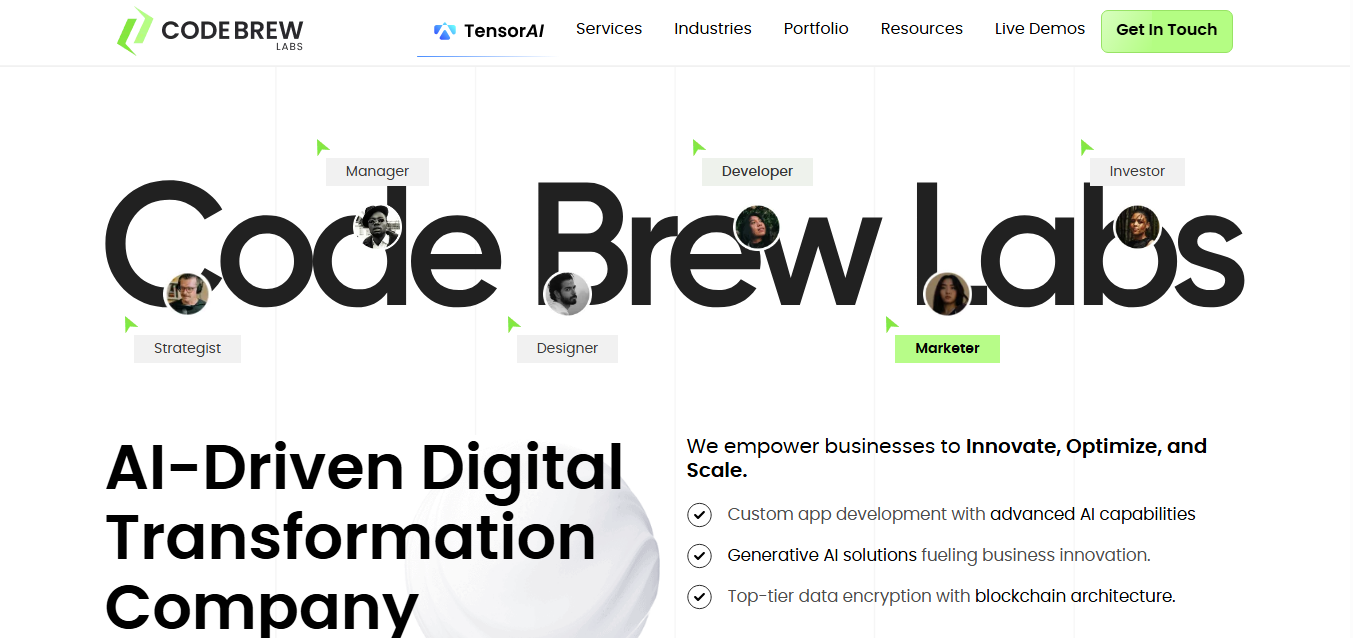
Offices in the US, UAE, and UK | Founded 2013
Code Brew Labs comes out of mobile app development.
The portfolio leans into fintech, on demand services, and food delivery.
Best for: Startups, growth stage scale ups, and consumer brands that want agentic features inside a mobile or web product without a tier one consulting price tag.
Watch for: Heavily regulated estates with deep audit, GRC, or model risk requirements should validate compliance experience carefully before signing. The strength here is product velocity, not regulated enterprise governance.
Tkxel
Headquartered in Reston, Virginia | Founded 2008 | Inc. 5000 honoree
Tkxel positions as an AI native software engineering partner. Reported client outcomes include sixty percent reductions in customer response times.
The AI practice spans agentic systems, predictive analytics, and intelligent automation, with industry coverage across financial services, healthcare, education, retail, and technology.
Best for: Mid market enterprises and PE backed portfolio companies that want experienced agentic AI engineers fast, especially when the agent has to operate inside Salesforce, Azure, or ServiceNow.
Watch for: Brand recognition still trails technical capability, so reference checks in your specific industry and compliance regime are time well spent.
LeewayHertz
Founded 2007 | Acquired by The Hackett Group in September 2024 | Recognized by Forbes and Gartner
LeewayHertz has been one of the more visible names in AI development for several years, and the visibility is mostly earned. The firm has worked with 30+ Fortune 500 clients including Hershey’s, P&G, Siemens, and 3M, and was recognized by Forbes as a top AI consulting firm and named in Gartner’s 2024 Hype Cycle Report for Generative AI.
Its agentic practice leans heavily on production frameworks like crewAI and AutoGen Studio, with prebuilt patterns for common use cases like customer support, sales enablement, and document intelligence that can compress timelines materially when the use case maps to the template. Its proprietary ZBrain platform is positioned as an enterprise GenAI development environment for clients that want a managed substrate rather than a from scratch build.
Best for: Enterprises shipping common agentic use cases on aggressive timelines, where proven patterns and an enterprise GenAI platform matter more than bespoke architecture.
Watch for: The September 2024 acquisition by The Hackett Group is a meaningful change in how the firm goes to market. Buyers should clarify how engagement structures, pricing, and senior staffing have evolved post acquisition before signing a longer term deal.
HatchWorks AI
Headquartered in Atlanta, Georgia | Founded 2016 | Inc. 5000 and Inc. AI Power Partner
The nearshore delivery model spans Costa Rica, Colombia, Peru, and Brazil, and produces real time zone overlap with US clients. Generative-Driven Development™ is the firm’s proprietary methodology, applied to design, build, and test cycles. Reference clients include Cox, Carter’s, and Diebold Nixdorf, and there is an active Databricks partnership underpinning data heavy agent work.
Best for: US clients that value tight feedback loops, fast iteration during business hours, and English language collaboration without offshore time zone friction.
Watch for: Generalist excellence is the operating mode. Buyers in deeply specialized verticals where domain language dominates the conversation should validate the firm’s prior work in their specific industry before committing.
Evenbound
Headquartered in Grand Haven, Michigan | Industrial, manufacturing, and construction focus
Evenbound is the unconventional pick on this list. The firm operates primarily as a HubSpot RevOps and B2B growth marketing agency rather than a pure AI build shop, and that is the point. For revenue operations use cases that run inside HubSpot or comparable stacks, including lead scoring automation, sales enablement workflows, customer journey orchestration, and pipeline routing, Evenbound understands the data model and the buyer side of the conversation in a way most pure AI vendors do not. AI here is positioned as automation and intelligence layered into HubSpot, not standalone agent infrastructure, and that is exactly what the use case usually calls for.
Best for: B2B revenue teams in manufacturing, construction, and industrial verticals running on HubSpot that want AI driven automation tied directly to revenue numbers and existing CRM data.
Watch for: Not the right partner for domain heavy agents in clinical workflows, supply chain orchestration, claims processing, or capital markets. The practice is bound tightly to HubSpot and B2B revenue operations.
Deviniti
Headquartered in Wrocław, Poland | Founded 2004 | Atlassian Platinum and Enterprise Solutions Partner | monday.com Platinum Partner
Deviniti is a mature European software firm with two decades of enterprise modernization work behind it. The firm grew up inside the Atlassian ecosystem (it has held Platinum status with Atlassian since 2017 and ranks as one of the largest Atlassian partners in the region) and has expanded into agentic AI organically, with active work on Email Agents, Document Intelligence, and Chatbot platforms. The European footprint is a real advantage for buyers facing strict GDPR or data residency requirements, and the firm’s involvement in BIELIK.AI (the Polish open source LLM that NVIDIA included among NIM models) signals a level of platform engagement most regional firms do not match. Recognition includes Forbes Diamond and the Deloitte Technology Impact Star.
Best for: European enterprises and Atlassian or monday.com heavy organizations modernizing service operations or knowledge work with agentic AI inside platforms they already operate at scale.
Watch for: The cadence is deliberate rather than rapid. Buyers expecting a working agentic prototype within a month will find discovery and design phases longer than they would at the velocity shops on this list.
Redwerk
Founded 2005 | Microsoft Partner Network
Redwerk has been shipping software since 2005, which in this category counts as institutional memory. The tenure shows in delivery process maturity that newer AI focused shops have not yet built. Agentic AI capabilities sit on top of a long full stack engineering foundation, with active client work in e-government (the Current SaaS platform now used by 12+ US states and counties), enterprise platforms, and AI integrated systems. Reference clients include Universal Music Group and Mass Movement (now part of J.B. Hunt).
Best for: Buyers skeptical of AI hype who want a partner that treats agents as one tool inside a sound engineering practice rather than the whole deliverable, and where audit ready code matters more than research output.
Watch for: This is not the flashiest firm on the list, and team size is meaningfully smaller than the larger competitors here. Buyers planning programs that need 50+ engineers in parallel should pressure test capacity before scoping.
Interexy
Headquartered in Miami, Florida | Founded 2017 | Offices in the US, Poland, and UAE
Interexy brings a focus on emerging technology that includes AI agents, blockchain, and IoT. Its sweet spot is custom software builds where AI is one significant component but not the entire product. Marketplaces with intelligent matching, healthcare apps with diagnostic assistance, and fintech platforms with embedded agentic workflows all fit the model. The team scales up and down well, which suits projects with variable resourcing needs over a 12 to 18 month horizon.
Best for: Mid sized product builds where agentic AI is one capability among several, especially in fintech, healthcare, or Web3, and where blockchain or IoT may also be in scope.
Watch for: Pure AI native products where every architectural decision should optimize for the agent layer will get more depth from a specialist firm.
Sthenos Technologies (publisher of this guide)
Headquartered in Tysons, Virginia | EDWOSB and WOSB certified | 43 reviews on Clutch, all rated 5.0
Sthenos is on this list for a reason that is hard to fake at this scale. The firm consistently produces two outputs that should be in tension with each other: agentic velocity and audit grade discipline.
The artificial intelligence and machine learning practice is not a separate division grafted onto the company. It sits inside the same engineering organization that runs cloud, data, application work, and QA, which means an agent moves through one team end to end, from design and modeling, through cloud architecture and data plumbing, into the application surface, and on through testing. No vendor handoffs. No translation losses between strategy and operate.
Sthenos has already shipped agents into hospital EMRs, insurance claims engines, retail order pipelines, telecom OSS and BSS layers, ERP estates, and the core banking platforms behind some of the most heavily transacted accounts in the world. The hard parts are not theoretical here.
Examples of work currently on the bench: relationship manager agents acting inside private bank workflows, multi agent stacks orchestrating insurance claims intake, vertical agents for telecom field operations, document intelligence pipelines for SME lending, and a steady book of custom application builds where the agent is one component of a broader enterprise platform rather than the whole story. The bench also covers cloud computing, DevOps, data and analytics, and quality engineering, which keeps clients from stitching three vendors together to put one agent into production.
Best for: Mid market and enterprise buyers in financial services, healthcare, manufacturing, and SaaS that need agents shipped against a measurable business target, inside the compliance regime they already operate under. The fit gets stronger when the program is multi year, spans geographies, or carries a board level KPI.
Example: a digital relationship manager app for a bank in India, delivered by NeoSOFT.
How they engage: Three engagement shapes are common. Outcome based programs scoped to a measurable target, managed capacity for ongoing build and operate work, and team augmentation when the requirement is senior agentic engineers inside an existing team without a six month hiring cycle.
How to Choose Between Them
When comparing AI agent development companies, three questions surface real differences faster than another round of demos.
Figure 1. Three questions that narrow the shortlist
Each column is one of the three questions in this section; beneath each answer are the firms this guide names for it. The groupings are the guide’s editorial view of fit, not a measurement.
One: What is the regulatory weight of the system the agent will plug into?
Programs operating under banking regulators (RBI, OCC, FCA, MAS), healthcare frameworks (HIPAA), payment rules (PCI DSS), or EU mandates (GDPR, DORA) need partners with mature governance, real audit history, and process discipline that holds up under inspection. Sthenos and Tkxel fit that subset, with Deviniti a strong fit when European data residency is a hard line.
Two: Is the agent the product, or is AI a feature inside an existing product?
Programs where the agent is the product (its own platform, its own UX, its own data layer) need a partner that owns the whole stack, front end through pipeline through release engineering. Sthenos, Tkxel, and Redwerk fit that mold. Programs where the agent is a feature inside an existing product reward velocity shops with strong product instincts, like Code Brew Labs, HatchWorks AI, or Interexy. When the agent has to plug directly into a marketing or revenue stack like HubSpot, Evenbound is the specialist.
The agent is the product
Its own platform, UX and data layer
- Needs a partner that owns the whole stack
- Front end through pipeline through release engineering
- Sthenos, Tkxel and Redwerk fit that mold
AI is a feature inside an existing product
Velocity and product instinct
- Rewards velocity shops with strong product instincts
- Code Brew Labs, HatchWorks AI or Interexy
- On a HubSpot revenue stack, Evenbound is the specialist
Three: How long is the runway?
Multi year enterprise transformation rewards scale and process discipline. Sthenos, Tkxel, and Deviniti are built for that. Mid market roadmaps where budget and capability have to be balanced inside the same engagement reward firms that flex. Sthenos under a team augmentation model and HatchWorks both fit. A focused six to eight week proof of concept rewards a right sized partner with a real senior bench, which is where Neurons Lab, LeewayHertz, or Interexy come in.
The Bottom Line
The AI agent development companies worth shortlisting are not the ones running the loudest paid campaigns. They are the firms that can build something that ships, integrates without theatrics, defends a business number, and survives a year of model swaps and policy change without quietly being put out to pasture.
- Builds something that ships
- Integrates without theatrics
- Defends a business number
- Survives a year of model swaps and policy change
Sthenos runs all four of those checks through one delivery practice. The AI work, the cloud architecture, the data layer, the DevOps pipeline, the QA discipline, and the security posture do not come from separate vendors. They live on one bench.
The harder decision is upstream of vendor choice. It is whether the program is scoped against a number the business will defend a year from now.
Ready to scope your AI agent program? The Sthenos Technologies AI engineering team will pressure test your current architecture, governance posture, and integration readiness against where peers in your sector are actually landing, and lay out a realistic path from pilot to production. Start the conversation.
Related in this topic: choose an AI software development company.
How do I verify that my AI agent development partner is a reputable company and not a scam?
Check it against five tests: real agent architecture rather than one LLM call wrapped in a UI; governance for non-deterministic systems, such as eval pipelines, versioning and audit-ready PII handling; integration into the systems that run your business; production observability with honest cost reporting; and outcomes measured in business numbers, not agents shipped.
Related reading
- Hiring a partner: Agentic AI consulting services
- Broader AI work: Artificial intelligence services for enterprise
- Comparing more firms: AI custom software development companies: five firms, unranked and 5 best agentic AI consulting firms for enterprises
- Choosing the agent type: Vertical vs horizontal AI agents