App Development Services for Web and Mobile Products
Updated

















Web and Mobile App Development Services
Mobile App Development Services
Responsive Web Applications
Cross-Platform App Development
Progressive Web Applications (PWA)
IoT Web and Mobile App Development
API Development & Integration
Back-End Development

How We Build Web and Mobile Applications
Engineering-First Mindset
Great applications start with solid engineering decisions. We take time to understand your business workflows, users, and constraints before writing a line of code. That discipline shows up in systems that scale cleanly and don’t collapse under real usage.
DevOps-Ready Full-Stack Teams
Our teams build and deploy with automation in mind from day one. CI/CD, environment parity, and release discipline are baked into how we work, helping teams move faster without losing control or reliability.
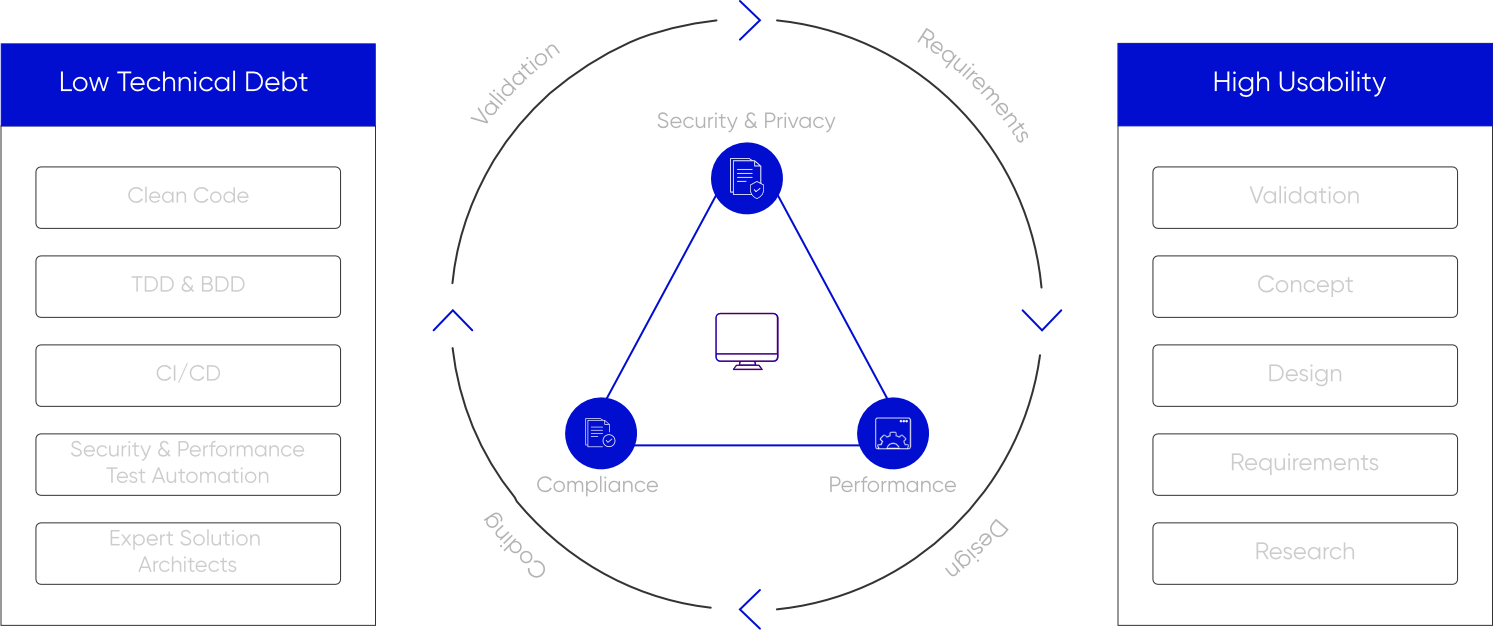
Low Technical Debt by Design
We avoid shortcuts that create long-term problems. Through clear standards, thoughtful architecture, and regular refactoring, we keep systems maintainable so your teams are not paying for yesterday’s decisions tomorrow.
High Usability, Not Just Clean UI
Usability is not a visual layer added at the end. Designers, engineers, and QA work together to ensure applications are intuitive, accessible, and consistent across devices and real user scenarios.
True Partners in Innovation
We don’t operate as a ticket-based vendor. We work alongside your teams to explore ideas, challenge assumptions, and build solutions that move the business forward, not just deliver features.
Proven Execution Framework
Our delivery approach balances structure with flexibility. Clear milestones, frequent feedback, and incremental delivery ensure projects stay on track while adapting to changing requirements.
App development at Sthenos covers two products, a web application that runs in the browser and a mobile application for iOS and Android, and the layers underneath both: cross-platform code, progressive web apps, IoT, APIs and the back end. This page is the hub for them. The sections below say which Sthenos page answers which question, place the seven services above in one application, compare the ways to reach users, and set out how a build runs, what moves the cost, what you hold at the end and what to ask.
From mobile app development and responsive web applications to API development and the back end. Counted on this page.
Native and hybrid mobile apps across iOS and Android, and web apps that work across browsers and devices.
Per hour, depending on the seniority and mix of the team. The published Sthenos band.
Working software arrives every two weeks, as published on our about page.
On this page
- Which Sthenos page answers your question
- Where each service sits in one application
- Web app, mobile app or one codebase for both
- How a build runs, from discovery to support
- What moves the cost of a build
- What you receive at handover
- What to ask before you hire
- Questions buyers ask before they start
- Related pages, by what you are building
Which Sthenos page answers your question
A hub is the short version. Each page below carries the long one, with its own process, costs and buyer questions. Start from what you are building.
| What you are building | Where to read next | What that page covers |
|---|---|---|
| An app for iOS and Android | Mobile app development services | Enterprise mobile strategy, user experience, custom mobile app development, application testing, integration, deployment and support, and dedicated mobile app developers. |
| A web application people log in to and work in | Web app development services | Enterprise business solutions, custom application development, back-end and front-end development, and DevOps practices across the web development lifecycle. |
| A website, a marketing site or a redesign | Web development services | The four products sold under the name web development, from a template build to a platform or portal, and what moves the price of each. |
| Software for a large organisation, with its governance | Enterprise software development services | The same engineering with the governance, integration surface and scale an enterprise programme carries. |
| Quality for an app you already run | Software testing services | Automation, performance, security, functional, compatibility and manual testing, as quality assurance across every stage of the SDLC. |
| A first version, to prove the idea | MVP development | One core workflow, in front of real users, to prove or kill the idea before a full budget is committed. |
| A whole product, from strategy to analytics | Product development | Strategy, UX, engineering and analytics on one team, for a product that has to find a market. |
Where each service sits in one application
An app is more than the screen a user holds. Figure 1 places the seven services on this page on the path from that screen to your systems, using only the words the page already uses.
Figure 1. From the screen a user holds to the systems behind it, and the service that builds each part
Caption: every label is one of the seven services on this page, in its own words. Responsive Web Applications and Progressive Web Applications sit in the browser; Mobile App Development Services builds native and hybrid apps across iOS and Android; Cross-Platform App Development, API Development and Integration, and Back-End Development for cloud-native and hybrid deployment sit behind them; IoT Web and Mobile App Development connects devices, platforms and data. The bottom band is the High Usability tile above. Nothing in the figure is a measurement.
Web app, mobile app or one codebase for both: which one suits the product
The three answers below are the three this page sells, and each links to the page that goes deeper. Our mobile page puts the trade plainly: native earns its cost when you depend on the newest OS capabilities, heavy graphics or tight hardware access, and a responsive web app is often the right answer for internal tools that do not need the app stores at all.
Three ways to reach your users
A web application
Best for- Internal tools that do not need the app stores at all, which removes review delays entirely.
- Speed, accessibility and integration with your existing systems, across browsers and devices.
- Read the web applications page.
A native mobile app
Best for- The newest OS capabilities, heavy graphics or tight hardware access.
- A separate app per platform, Swift for iOS and Kotlin for Android, for the fullest access to each.
- Read the mobile apps page.
Cross-platform or a PWA
Best for- Most business apps: one codebase that runs on both iOS and Android.
- App-like experiences without the friction of app stores, fast to deploy and easy to update.
- Native vs cross-platform, compared.
How a build runs, from discovery to support
Five stages, the same five published on our software development services page. Sthenos works in two week sprints, so working software arrives every two weeks and a first production release typically lands in three to six months, as stated on our about page.
- DiscoveryThe problem, the constraints and the success criteria are mapped before a line of code. It is deliberately short and bounded, and it ends with a written scope and a costed roadmap.
- DesignThe decisions that are expensive to reverse, and the ones users will judge: data model, service boundaries, hosting, failure behaviour, and an interface that fits your users.
- BuildSenior engineers ship in short, reviewable increments, with automated coverage written alongside the feature rather than after it.
- LaunchHardening, testing and a controlled release, covering environments, the release pipeline and the rollback path.
- SupportMonitoring, maintenance and a roadmap tied to business outcomes, including the change requests that arrive the week after launch.
What moves the cost of a build
App work is billed at the published Sthenos rate band, and where the scope is clear we quote a fixed price for a defined outcome, with a costed roadmap before any build starts.
Within those bands, these are the questions that change an estimate. Each is already published on another page of this site, and none carries a number here.
What you receive at handover
A process description says what a vendor does. This says what you end up holding, which is the version worth checking a proposal against.
- The repository and the cloud accounts, in your name from the first commit.
- A written scope and a costed roadmap, before any build starts.
- Working software every two weeks, not a status report about software.
- Architecture and a security posture you can put in front of a reviewer.
- Infrastructure your own engineers can run once it is handed over.
- Monitoring, maintenance and a roadmap after launch, priced up front.
What to ask before you hire
These questions apply to any app vendor, Sthenos included, and each one comes from an answer or a question already published on this site.
- Who owns the code, the repository and the domain when we are done? All three should be in your name from the start.
- Which platform ships first, and what would make native worth two builds rather than one cross-platform codebase?
- Is the app store submission checklist in the plan, or is review being treated as a formality?
- What is explicitly out of scope? The excluded half is the half that generates change requests.
- Who reviews the code, and can that person veto a merge?
- Show me something you built that is still being maintained three years on. Anyone can show a launch.
Questions buyers ask before they start
Should we build a web app or a mobile app first?
It depends on who uses it and where. A responsive web app is often the right answer for internal tools that do not need the app stores, and it removes review delays entirely. Native earns its cost when you depend on the newest OS capabilities or tight hardware access. If budget is tight, pick one platform first and add the second once you have traction.
What is a progressive web application?
A web application that delivers an app-like experience without the friction of app stores. As the Progressive Web Applications service above describes, PWAs are fast to deploy and easy to update, and they suit organizations prioritizing reach, performance and cost efficiency.
Do you build the back end and the APIs, or only the app?
Both. API Development and Integration and Back-End Development are two of the seven services on this page: secure, well-documented APIs that connect applications, platforms and third-party services, and back-end systems that support both cloud-native and hybrid deployment models.
How much does app development cost with Sthenos?
Sthenos rates are $150 to $250 per hour, depending on the seniority and mix of the team, and a typical project runs $50,000 to $200,000. Where the scope is clear we quote a fixed price for a defined outcome, with a costed roadmap before any build starts.
How long does it take to reach a first release?
Sthenos works in two week sprints, so working software arrives every two weeks and a first production release typically lands in three to six months. A date more precise than that comes out of discovery, because it depends on scope rather than on goodwill.
Who owns the code when the app is finished?
You do, entirely, from the first commit. The repository and the cloud accounts are in your name, with no licence back to us and no dependency on us continuing to exist.
Related pages, by what you are building
Building a web or mobile app? Tell us who will use it, on which devices, and what it has to connect to, and we will help you determine which of our services best fit your needs. Request a free consultation.
Selected Clients Success Stories
Built a User-Centric Learning Platform for a Global Enterprise
We designed and delivered a modern learning platform focused on usability, performance, and scale. The system simplified content delivery, improved learner engagement, and integrated seamlessly with existing enterprise systems to support long-term growth.
10x
Increase in active learners

Modernized a Digital Lending Platform for a Financial Institution
We engineered a secure digital platform that streamlined the end-to-end loan lifecycle. By reducing manual steps and improving workflow automation, the solution accelerated processing time while strengthening data security and compliance controls.
54%
Increase in customer engagement

Delivered a Direct-to-Consumer Telehealth Application
We built a scalable telemedicine platform enabling secure, real-time interaction between patients and healthcare providers. The solution supported video consultations, scheduling, and digital prescriptions while maintaining strict data privacy standards.
35%
Increase in new customer acquisition

Outpacing the rate of disruption with
unmatched digital capabilities